Shades of Consent: Choosing an Exterior Door Colour That Satisfies Planners, Paint and the Street
A front door is the one part of a house obliged to satisfy three separate audiences at once: the local planning authority, the British weather, and the street it happens to face. Colour is where those three interests collide most obviously. The shade that looks striking on a colour card in a kitchen can read very differently on a north-facing elevation in February, on a listed terrace where the conservation officer has firm views, or on a south-facing composite door that will spend the summer absorbing heat.
What follows is a methodical approach to the decision — planning first, performance second, aesthetics third. In practice, that order saves a great deal of money.
Establish the rulebook before opening a colour chart
The single most common error is to choose a shade and then discover it is not permitted. Begin instead with the question of what your property is subject to.
If the house sits within a conservation area, the local planning authority has an additional layer of control over the appearance of development, including the treatment of elevations. Painting a front door is often treated as permitted development, but this is not universal. An Article 4 direction can withdraw those freedoms for specific works, and a number of authorities have used such directions precisely to control doors, windows and boundary treatments. Check the council's planning portal, its conservation-area appraisals and any adopted design guidance before proceeding, and where the position is unclear, seek pre-application advice in writing.
For listed buildings the position is firmer. Listed building consent is required for works of alteration that affect character as a building of special architectural or historic interest, and the external painting of a door can fall within that definition, particularly where the door is original or contributes to the significance of the building. Practice varies between authorities, so a short enquiry to the conservation officer is time well spent. Keep any written confirmation on file; it is invaluable if a neighbour later raises a concern.
Beyond the statutory framework, check whether the property is covered by a neighbourhood plan, a design code, or an estate management scheme with design guidance attached. These documents frequently specify acceptable palettes for doors, and compliance is usually a condition of the covenant rather than a matter of preference.
The obligations that sit outside planning
Not every constraint is public. Freehold titles frequently carry restrictive covenants limiting the colour or style of external joinery, particularly on estates built in the twentieth century. Leaseholders should consult the lease and the managing agent's handbook; uniform door colours are a common requirement in purpose-built blocks, and consent is generally required before any change.
It is worth reading the title documents even where no enforcement seems likely. Covenants tend to surface at the point of sale, when a solicitor's enquiry lands in the middle of a conveyancing chain.
Where colour meets weather performance
Once the legal position is clear, the practical question is how a finish behaves on your particular elevation. Colour and coating are separate variables, and confusing them leads to disappointment.
Dark pigments absorb solar radiation. On a south- or west-facing entrance, a near-black or deep navy door can reach surface temperatures considerably above ambient, and that heat drives thermal movement in timber and stressing in some composite skins. Over several seasons this can accelerate film failure — cracking, blistering and flaking — particularly where the coating system is thin. Dark doors also reveal dust, pollen and salt deposits more readily, and on exposed coastal elevations the combination of wind-driven rain and airborne salt makes frequent cleaning unavoidable.
Pale colours present the opposite problem. They reflect heat and are generally more forgiving thermally, but they chalk, they show traffic marks, and on north-facing elevations they are prone to algal and mould staining in damp conditions. There is no neutral option that escapes maintenance; there is only a choice about which maintenance you would rather do.
Factory finish against site-applied paint
A factory-applied coating — powder-coated aluminium, or the baked finishes used on composite doors — is formulated and cured under controlled conditions and typically carries a warranty of ten years or more against blistering and cracking. That durability is the principal argument in its favour, and it matters most on exposed sites.
Timber doors offer greater flexibility and are the appropriate choice in many period settings, but they demand a proper coating system: a primer, an undercoat and at least two topcoats, with the specification adjusted for the colour. Deep shades on timber should be avoided in strongly exposed positions unless the joinery is well sheltered and maintained on a short cycle. Where a dark colour is essential, an engineered timber such as Accoya, which is dimensionally stable and takes coatings reliably, reduces the risk considerably.
In either case, ask what the repainting cycle is likely to be. A pale or mid-tone timber door in a sheltered position may last seven or eight years between full decoration; a dark one in full sun may halve that.
Test the shade in the place it will live
Colour cards are unreliable. Obtain physical samples — many manufacturers supply A5 or A4 swatches — and view them against the actual wall, at the actual entrance, in morning light, afternoon light and under cloud. A shade that appears warm on a west-facing brick elevation can turn grey on a north-facing render.
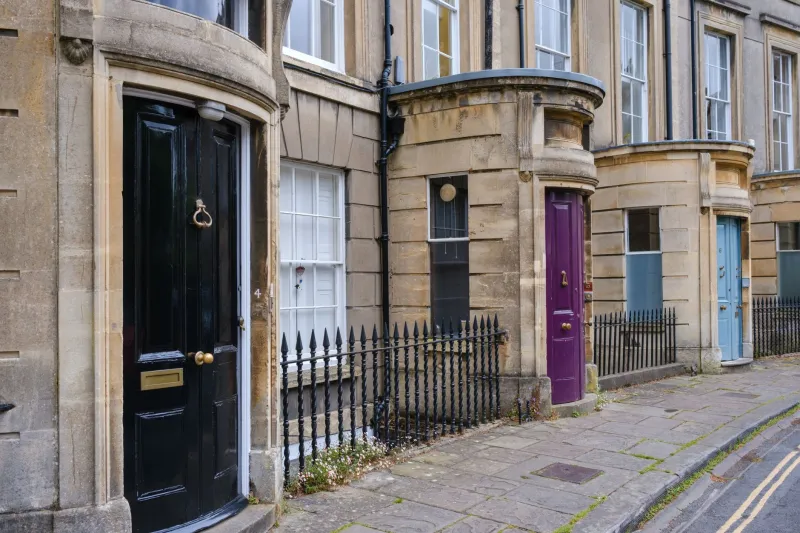
Consider the wider street as well. There is a difference between a door that complements a neighbouring palette and one that competes with it. A single strong colour among a row of muted shades can look deliberate; three competing statements in the same terrace rarely do. If your property is one of a pair or a symmetrical pair of semis, the relationship to the neighbour's door carries extra weight.
Finally, look at the whole assembly rather than the panel alone. Hardware finish, glazing bars and sidelights all affect how a colour reads; a dark green door with unlacquered brass bears little resemblance to the same green with polished chrome.
A short pre-commitment checklist
- Confirm conservation-area status, any Article 4 direction and any listing, and obtain written advice where the position is ambiguous.
- Read the title, lease or estate guidance for colour covenants.
- Record the orientation and exposure of the entrance; south and west elevations punish dark finishes.
- Request physical samples and view them in situ across a full day.
- Ask for the coating system, the warranty terms and the recommended redecorating interval in writing.
- Discuss the choice with immediate neighbours before ordering, not after fitting.
A door colour is a long-term decision, and the most satisfying results come from treating it as three linked questions — permission, performance, appearance — rather than one. Answered in that order, the shade that survives the tribunal is usually the one that still looks well a decade later.