Garden Access, Locked Down: Specifying and Maintaining Patio Doors for the British Year
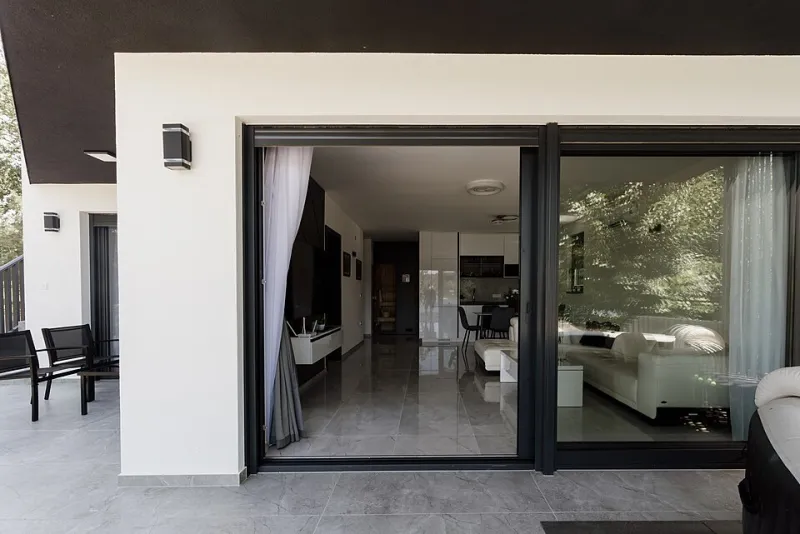
Photo: Shixart1985, CC BY 2.0, via Wikimedia Commons
Patio doors occupy a difficult position in the British home. They are expected to open wide on a warm evening, keep out driving rain in November and present a credible barrier after dark. Those aims pull in different directions. A wide opening demands large glazed panels and slender frames; weather-tightness demands compression and close tolerances; security demands locking points and resistance to lifting. The answer is not a single product but a specification and maintenance regime that recognises the trade-offs.
Three Systems and Their Trade-Offs
Lift-slide doors are the heavyweight option. The handle lifts the panel onto its rollers and, when closed, lowers it onto a compression seal. This gives strong weather performance and smooth movement for large panels, but the mechanism must be adjusted so the panel settles evenly. If it is left riding high, the seal never compresses and the door becomes a draught path.
Inline-slide doors run panels in separate tracks, often with a lower threshold. They offer generous clear openings and straightforward ventilation, but the interlocks and track drainage need regular attention. Multiple tracks can collect grit and leaf litter, and the closing panel relies on a robust multipoint lock rather than compression alone.
Bifold doors concertina to one side. They provide the widest opening and suit garden rooms, but each joint is a potential leak and each hinge a potential weakness. Bifolds are not inherently insecure, but they demand quality hinges, anti-lift blocks and a locking arrangement that secures every leaf. They also need more frequent cleaning of the head and bottom tracks.
Track Drainage in Plain Terms
Every external sliding or folding door has a threshold track that will collect water. Good systems manage it: the track is shaped to channel water to weep holes or drainage slots, and the threshold may be stepped or sloped outward. The water leaves by gravity, not by magic. If the weep holes are blocked by dirt, moss or insects, water backs up and finds its way inward, often appearing as damp patches at the internal floor junction. The remedy is simple but must be regular: clear the track, flush the drainage paths with water, and check that the brush seals are not trapping debris. On exposed sites, a raised threshold with a secondary drainage channel is often worth the small step.
Anti-Lift Hardware and Night Security
Sliding panels can be lifted out of their tracks if there is enough clearance. Anti-lift blocks or pins reduce that clearance and prevent the panel from being raised. On lift-slide doors, the same mechanism that lowers the panel onto its seal can assist security, provided the panel is fully closed and the handle is locked. Bifold doors need anti-lift devices at the hinges and a lock that secures the lead leaf to the frame. For any patio door, the lock should be multipoint, with hooks or bolts engaging the frame at several heights, and the glass should be laminated or toughened as appropriate. A key-operated handle is useful, but it is not a substitute for a well-adjusted door that closes squarely. If the door can be rocked in its frame, the locking points are not doing their job.
For new or replacement doors, ask whether the complete doorset has been tested to PAS 24, the security standard commonly referenced in UK building regulations for easily accessible doors. The test is on the whole assembly, not just the lock.
Seals, Rollers and the Winter Test
Cold-weather problems usually announce themselves as draughts, condensation or a door that suddenly needs a shoulder to close. Check the seals first. Compression gaskets should be pliable and continuous; brush seals should touch the track without being flattened. Rollers can be adjusted to raise or lower the panel, but small turns are enough. Lubricate with silicone spray rather than oil, which attracts grit. A simple draught test with a smoking incense stick or a sheet of paper can reveal where the seal is failing. If condensation forms on the inner face of the glass, the door may be leaking warm moist air past the seal; if it forms between panes, the sealed unit has failed.
A Seasonal Routine
In spring, clear tracks of grit and pollen, flush the drainage paths, check the locks and clean frames with mild soap rather than abrasive cleaners. If the door has a ventilation position, test it and confirm that it still locks securely when closed.
In autumn, clear the weep holes again, inspect the seals, replace worn brush strips, check the anti-lift blocks, tighten handles and hinges, and test the night lock. Trim plants that brush against the door and trap moisture.
In winter, keep the track free of grit and salt, do not force a frozen door, and check that security lighting covers the garden side of the entrance. Keys should be accessible in an emergency but not visible from outside. If the door is left open for ventilation in milder weather, use a restrictor or a secondary security barrier rather than relying on a single latch.
Specification Notes for British Homes
Choose the system to suit the opening, not the photograph. Lift-slide suits large panels and weather-exposed elevations; inline-slide suits simpler operation and lower thresholds; bifold suits maximum clear width where the garden is the main view. Ask for the doorset's weather rating, security certification and glass specification. In exposed coastal or upland locations, specify a higher-performance threshold and marine-grade hardware. For listed or conservation-area properties, check consent before altering the opening.
The patio door paradox is resolved by treating the door as a system: frame, glass, seals, track, drainage and hardware. A well-specified door, adjusted twice a year and cleaned when the track looks gritty, will ventilate in summer, seal in winter and lock at night. Neglect any one element and the compromise becomes visible, usually at the worst moment.